

There's No Homeschool Script
It's just [part of] a lie you've got to rise above

Over the past several years, I’ve become a go-to resource in my Jewish community for families who are considering homeschooling, a role that has grown out of both experience and necessity. We’ve been doing this for seven years now, long enough to understand how varied and customizable this path can be, and I also help run the legal compliance for families who choose to homeschool under a religious umbrella rather than submitting to county oversight. That combination tends to make me the first call when someone in the area starts entertaining the idea.
What continues to surprise me, though, is not the interest—it’s how little people understand what they’re asking about.
There’s a persistent belief that homeschooling must come with a script, that somewhere there exists a sanctioned program, ideally one endorsed by the same system families are trying to step away from. People imagine that once they opt out, someone hands them a curriculum and a daily schedule, a tidy set of instructions that ensures they’re doing everything “correctly.” The entire framing suggests that what they’re really looking for is not freedom, but structure—preferably structure that comes with institutional approval.
The reality is far less comforting, and for some, far more difficult to accept.
The law requires that homeschooled children receive “regular, thorough instruction” in the subjects typically taught in public school—math, English language arts, history, and health. But that language leaves enormous room for interpretation. There is no mandated curriculum, no official sequence of lessons, no single authority dictating how your day should unfold. What “regular” and “thorough” look like in your home is, quite intentionally, left up to you.
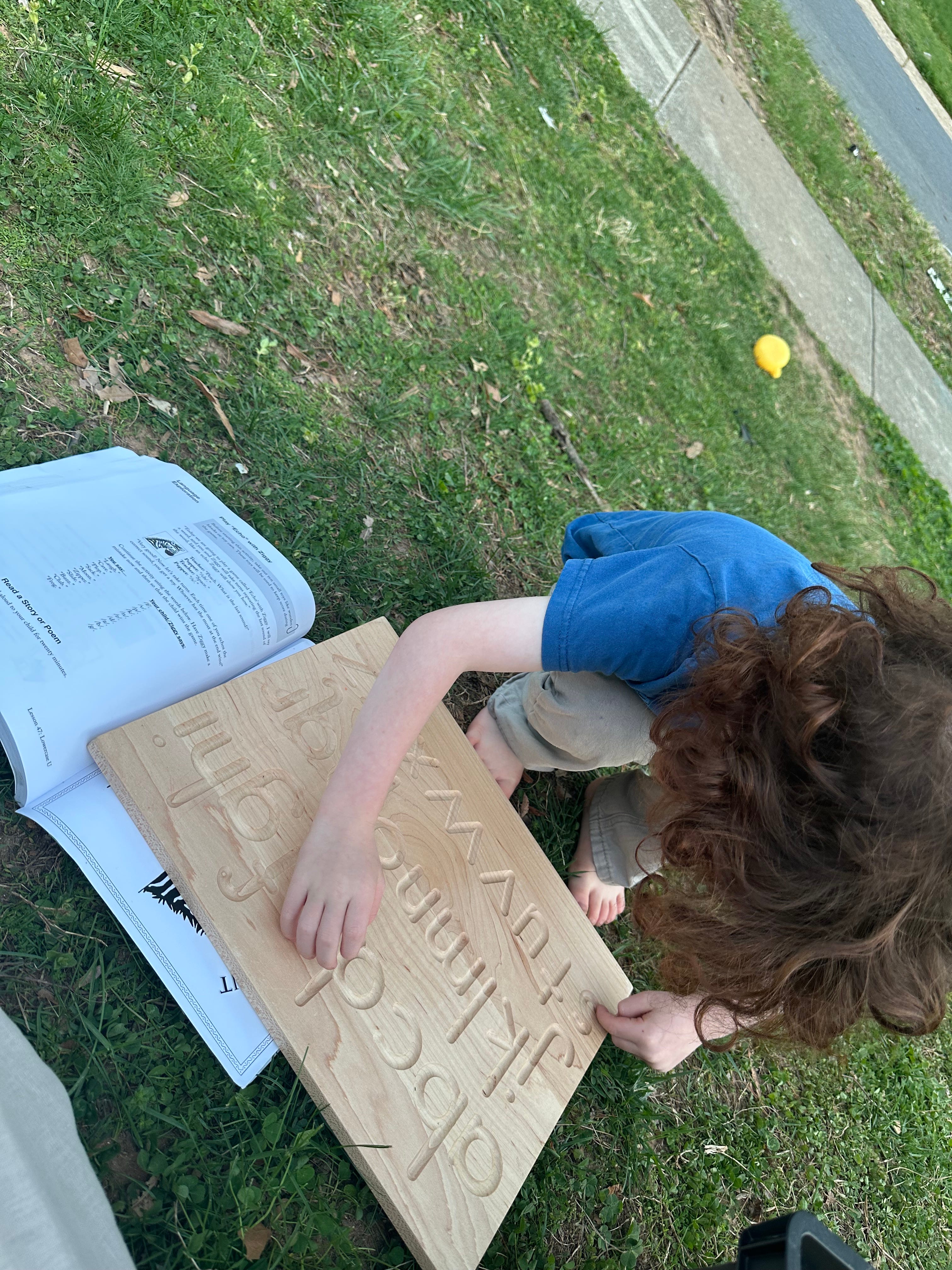
Which means that instead of a program, you are handed responsibility.
There are countless curricula available, spanning every imaginable philosophy and approach, and families are free to choose, combine, abandon, and adapt them as needed. For some people, that level of autonomy is the entire appeal. For others, it triggers a kind of panic that reveals how deeply we’ve been conditioned to expect someone else to set the rules.
“I just want the program,” people tell me, emphasizing the word as though the problem is simply that I haven’t pointed them to the right one yet. But what they are asking for does not exist. There is no singular, correct way to homeschool, no guaranteed path that removes the need to make decisions.
“What do the schools use?” comes next, as if the answer might offer a shortcut back to something familiar. But schools don’t make their full curricula public (isn’t that interesting?), and more importantly, that isn’t the point. If the system were working well enough to replicate, they wouldn’t be calling me in the first place.
And then, almost inevitably, the question that reveals the real tension: “Is there somewhere I can send my child so they can be homeschooled?”
At that point, it becomes clear that many of these families are not actually looking to homeschool. They are looking for a different school—something that exists within the same framework, but feels safer, better, more aligned. They want out of their school and are simply looking for another, because they’re uninterested in relinquishing the structure they’ve been taught to rely on.
But if the system isn’t working, it’s worth asking why the instinct is to stay within it at all. Why look for a different school within the same model, instead of questioning the model itself?
Homeschooling is not simply a different location for education; it is a fundamentally different approach. It requires you to accept that there is no central authority quietly ensuring that you are doing everything “the right way,” because there is no universally agreed-upon “right way” to begin with.
That idea is uncomfortable, and not just in education.
When I was a teenager, one of my favorite songs was No Such Thing by John Mayer. There’s a line that always stuck with me: “I just found out there’s no such thing as the real world… just a lie you’ve got to rise above.” At the time, I understood it as a kind of rebellion against the rigid, linear path we were all expected to follow—school, college, career, stability, all neatly laid out in advance.
What appealed to me then, and what resonates even more now, is the idea that much of what we treat as fixed and inevitable is actually constructed. The “rules” we think we have to follow are often just conventions we’ve inherited, rarely examined, and even more rarely challenged.
Homeschooling forces that realization in a very concrete way. It strips away the illusion of a default setting you can fall back on and replaces it with something both more demanding and more honest: the understanding that you are responsible for building the structure yourself.
The families who succeed in this space are not the ones who find the perfect curriculum or the most authoritative program. They are the ones who are willing to sit with uncertainty, make decisions without guarantees, and adjust when something isn’t working. They recognize that the goal isn’t to recreate school at home, but to create something better suited to their children and their values.
Breaking out of the mold isn’t just about rejecting a system; it’s about accepting the responsibility that comes with that rejection. It means acknowledging that there is no master plan waiting to be handed to you, no single correct path that will ensure everything turns out exactly as you hope.
There is no “the program.”
There is only the willingness to step outside of what is familiar, to question assumptions that have gone unchallenged, and to build something of your own—even if it means doing so without a map.