

How to Raise a Reader
As best you can, at least.

New scores from the NAEP, the educational assessment often called The Nation’s Report Card, dropped this week, and they signal yet another bright flashing danger sign about the sorry state of both our education system and our broader culture.
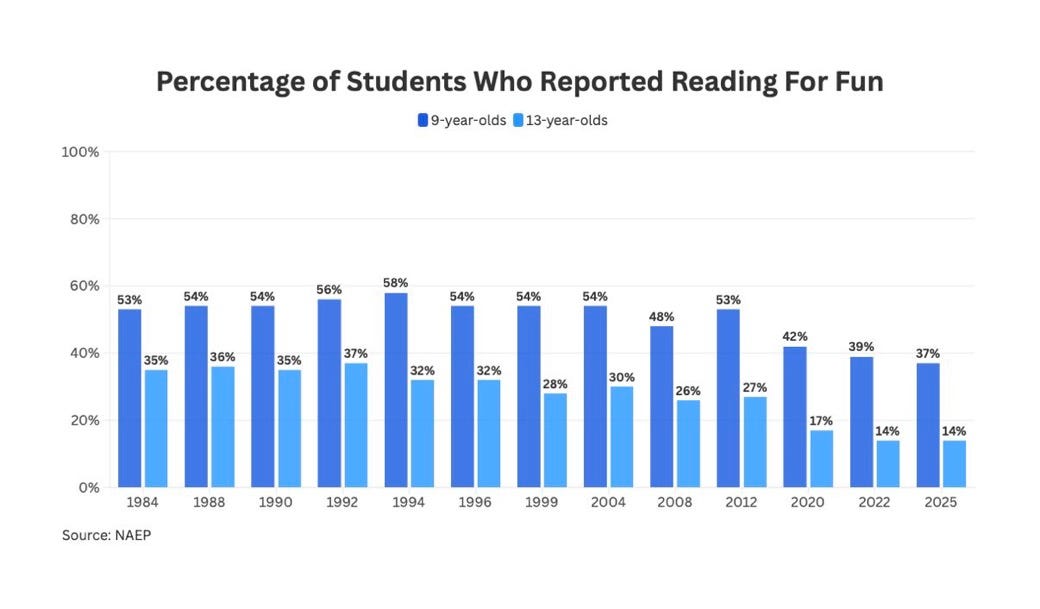
The percentage of children who read for fun is steadily dropping. For nine-year-olds, the number hovered around 55 percent for decades before 2020, when it suddenly began to decline dramatically. Today, just 37 percent of children in roughly second or third grade say they read for pleasure.
Among thirteen-year-olds, the numbers are even more troubling. For most of the past several decades, the percentage of people who said they enjoyed reading for fun has lingered in the low 30s. The decline began gradually around 2008, but eventually accelerated into a free fall. Today, only about 14 percent of America’s early teenagers report reading for pleasure, roughly half the rate of previous generations.
I saw this new data come across my phone while I was sitting with my daughter and a few of her friends, all of whom are readers. Curious what they would say, I asked them a simple question: Why do you read for fun?
“Why do you ask?” one of her friends replied.
Before I could answer, my daughter jumped in.
“She’s using us for an article.”
Guilty.
But their answers were surprisingly insightful.
The number one thing they said that does it is that they spend a lot of time being bored.
They aren’t enrolled in a dizzying array of extracurricular activities. They aren’t constantly being driven from one organized event to the next. They often find themselves lounging around the house, looking for something to do, without the option of reaching for a screen whenever they feel the slightest twinge of boredom. Eventually, and often quite naturally, they pick up a book.
One of my favorite sayings is that boredom is the mother of creativity. It’s a state of being that modern parents seem increasingly unwilling to let their children experience, even though so many of the qualities we say we want our children to develop emerge from precisely those unstructured moments when nobody is directing their time or attention.
Instead, childhood increasingly looks like a relay race. Kids move from school to soccer practice to dance class to homework to a hurried dinner before collapsing into bed, only to wake up the next morning and do it all over again. Looking at many family schedules, it’s hard not to wonder what the purpose of all this running around actually is; are they running to something or running from something?
I suspect it’s a little bit of both.
Parents understandably want to provide opportunities for their children, especially in a world that feels increasingly competitive and uncertain. At the same time, I think many parents of my generation have become deeply uncomfortable with stillness. An empty afternoon feels wasteful. A child sprawled on the couch with nothing to do feels like a problem to solve. We have absorbed the idea that every moment must be optimized, every interest cultivated, every potential talent discovered and developed before some invisible window closes forever.
In the process, though, we may be depriving children of one of the greatest advantages they possess: the freedom to discover interests for themselves rather than having every interest curated for them.
The truth is that we have no idea what the world will look like by the time today’s children reach adulthood. We don’t know which skills will prove valuable, which careers will exist, or which industries will emerge. We don’t know whether all of those sports leagues, coding camps, enrichment programs, and specialized lessons will ultimately provide a meaningful advantage. What we do know is that people who can think independently, entertain themselves, solve problems, and sustain their attention without constant external stimulation will always be valuable, no matter what the future looks like.
I saw this principle at work recently when I left my eleven-year-old son, who is probably the least voracious reader among my children, home for the day with very little to do and firm limits on screen time. When I left the house around 10 a.m., he was sitting in a chair in our home library, reading graphic-novel adaptations of classic works like Hamlet and Frankenstein. When I returned four hours later, he was still sitting in that same chair, having worked his way through the entire stack.
Another important piece of this puzzle, and one my husband is infinitely better at than I am, is modeling the behavior you hope to see.
That means reading to your children, certainly, but it also means allowing them to see you reading for your own enjoyment. Adults are just as vulnerable to the pull of screens as children are. We carry our phones everywhere. We fill waiting rooms, checkout lines, and quiet moments with scrolling. We complain that children don’t read enough while allowing them to watch us spend every spare second staring into glowing rectangles.
My husband spends hours every weekend reading, especially on Shabbat, and often spends an hour reading before bed as well. He is one of the most widely read people I know, because he has made reading a normal and valued part of his life. Our children see that, and whether they realize it or not, they absorb the lesson.
I also want to circle back to that home library for a moment. We have an absurd number of books. Part of the reason is my own impulsivity; I’ll see a recommendation online and immediately order a used copy for four dollars. Another reason is that for a year and a half, our local library system was effectively closed as part of my county’s COVID response, which forced us to build a much larger collection at home than we otherwise would have.
And that brings us back to those NAEP charts.
The steepest decline in the percentage of children who say they enjoy reading for fun began in 2020.
That is not a coincidence.
The pandemic was not simply the year schools closed. It was also the year many American families quietly abandoned whatever screen-time boundaries they had previously maintained. Tablets became educational tools, social lifelines, babysitters, and entertainment devices all at once. Parents who were trying to work, manage households, and survive an unprecedented disruption understandably loosened restrictions that once felt important.
I’m not an anti-screen parent. I think television shows and movies can create meaningful family experiences, and I think video games can provide a level of immersion and enjoyment that is genuinely valuable for many children, especially my boys. But screens and books are not competing on equal terms. One is engineered by some of the most sophisticated minds in the world to capture and hold attention for as long as possible. The other requires effort, patience, and concentration before it delivers its rewards.
When people look at these NAEP scores, they often search for a policy solution. They want a new literacy initiative, a curriculum reform, a federal grant program, or a school-based intervention. Some of those things may help at the margins. But the deeper problem isn’t happening primarily inside schools.
The collapse in reading-for-fun is a reflection of what has happened to childhood itself.
Children become readers when books are readily available, when adults model reading, when boredom is allowed to exist, and when there is enough quiet space in their lives for curiosity to flourish. Reading isn’t merely another academic skill. It is a habit of attention, and attention is becoming one of the scarcest resources in modern life.
The chart showing fewer children reading for pleasure isn’t really a chart about reading at all. It’s a chart about what happens when every idle moment is filled, every silence interrupted, and every flicker of boredom immediately extinguished. If we want to raise children who read, think, imagine, and create, we may need to stop asking how to make books more entertaining and start asking why we’ve become so afraid to let our children be bored.
This has to be one of your best pieces, Bethany. Just wanted to comment on the busyness. So many parents in my world have their kids scheduled to the hilt with sports. It’s honestly deeply depressing anymore because if you aren’t part of that pervasive subculture of sports, your kids seemingly get left out of a lot. I’m starting to think organized sports are just as great a threat to childhood as excessive screens (I’m also not anti-screens entirely). Kids have no free time, no playtime, no opportunity to explore their own interests. For our family, we’ve decided our son is not going to be a part of it. I’ve signed him up for scouts, he has weekly swim lesson lessons, and right now he does a single sport with the YMCA on Saturday mornings and that’s it. This is more than enough and I think it gives him enough free time during the week to play and explore other interests. Finding people that share your values on parenting seems more difficult than maybe it was for my parents.