


This year marks our eighth year of homeschooling. I have now been homeschooling longer than I was in the “working” world.
We’ve cycled through many curriculum companies and options over the years, with some more successful than others. We straight-up abandoned a few (the Alveary chief among them), but with many others, we simply exhausted their offerings after loving everything we did with them for years (Beautiful Feet Books and A Gentle Feast).
This year, we made four big changes to our homeschool routine, and just a few weeks in, we’re absolutely loving the breath of fresh air each one is bringing to our days.
1. All About Math
If you’ve read this Substack, you’ve seen my serious struggles teaching my younger daughter to read. I tried four curricula and lost my cool more times than I can count. It got to the point where I hired a professional to evaluate her (wow, that was expensive), but she pointed me toward the Orton-Gillingham approach: a direct, explicit, multisensory, sequential method designed to teach reading, spelling, and writing, especially to kids with dyslexia.
My kid didn’t end up having dyslexia, but changing how I taught her kept her engaged enough to make enormous strides in reading. When we had her evaluated at the end of first grade, she was a year behind the average for children her age. By the end of last school year, she was a year ahead.
We used All About Reading with her and abandoned it in the middle of the second level because she simply didn’t need the training wheels anymore. We’ve also been using the pre-reading curriculum with my kindergarten-aged son; he started last year and is now about 75% of the way through it.
For as long as we’ve been homeschooling, we’ve used the same math curriculum: RightStart Math. It’s fantastic, but very game-intensive. I am not a fan of all the games, and as I had more kids doing math, I did fewer of them, especially as my kids got older. The problem was that the games were a crucial part of the curriculum, and we were leaving them behind.
This year, the same company that released All About Reading released a math curriculum called All About Math. I realized something while using their reading curriculum: my younger kids need more fun, hands-on activities, and I am not a mother who specializes in either.
Today, math with my three kids doing All About Math looked like this:
Kindergarten: He lined up the numbers 1–10 in order and then put the corresponding number blocks underneath each one. We then played a game where I hid one of the numbers, and he had to tell me which number was missing.
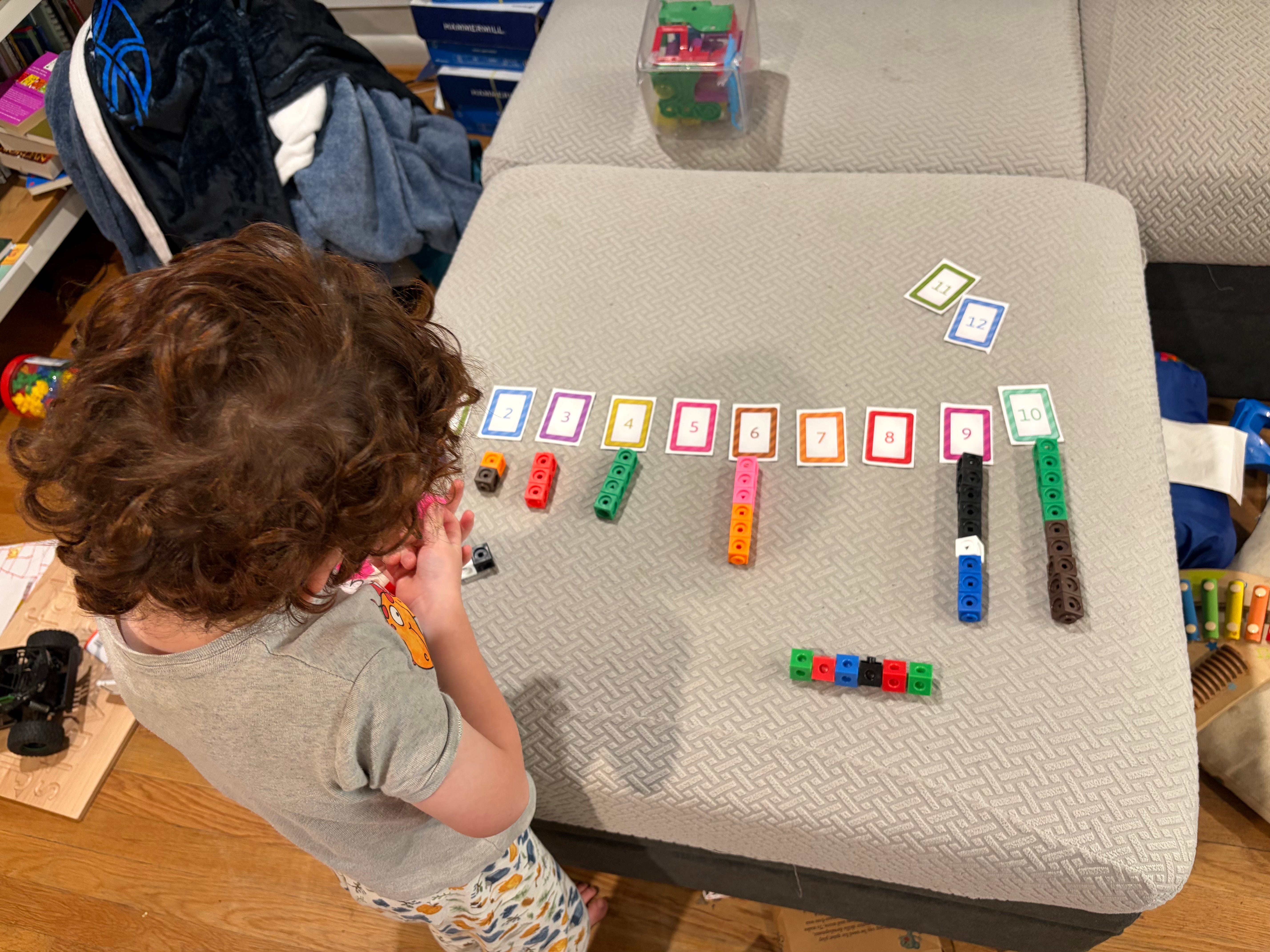
It was a simple game, and not one I couldn’t have come up with myself. The reality, though, is that I wasn’t coming up with these kinds of games, and they have real value at that age. I always say preschool and kindergarten are the hardest ages to teach for exactly this reason: everything we think is intuitive was actually taught to us by amazing, patient teachers when we were too little to remember what they did with and for us.
Second grade: We played multiple games (not card games, which is what RightStart focused on) to practice adding single digits to teen numbers. We worked through word and number problems, and when she got an answer right, she could add a topping to a pretend pancake from the activity workbook. Again, honestly, a really dumb game—so dumb I never would have come up with it myself—but it was extremely motivating and fun for her, which is ultimately all that matters.
Fourth grade: There are fewer games, but still plenty of hands-on activities. Instead of plotting numbers on a worksheet, the curriculum has kids put a piece of paper inside a dry-erase sleeve and use dry-erase markers to plot the graph. This is the multisensory focus the curriculum is great at: always changing up what they’re touching and doing so they don’t constantly feel chained to a pencil and workbook, which is real kryptonite to my second- and fourth-grade kids in particular.
2. BookShark
The second big change we made is to our language arts curriculum. When I first investigated homeschooling a decade ago, I settled on BookShark, but for reasons unknown, I chose the Alveary for our kindergarten year with my oldest daughter. I think it was because I bought in very hard on being a “Charlotte Mason” purist and needed a curriculum that passed that self-imposed purity test. I turned my nose up at the boxed curriculum, and I think I shot myself in the foot in the process.
Unlike our math curriculum, we’ve changed language arts curricula a great deal, never landing on anything we particularly liked. We did Alveary for a year, A Gentle Feast for four years (the language arts booklets that went along with the curriculum were a particular weakness of an otherwise enjoyable program), Memoria Press, and Moving Beyond the Page.
My frustration with all of them was that they weren’t rigorous enough and didn’t teach writing skills coherently. The best curriculum we used, Memoria Press, mired our kids in a handful of books and gave them way too much busywork for every chapter they read.
This year, we also reached a logical endpoint for the history curriculum we’ve used for years, Beautiful Feet Books, so I was in the market for both a new language arts and history curriculum. BookShark’s levels match the themes in both subjects, and I really liked the sample pages. They made academic sense, and the curriculum was intense about how much reading was expected at every age.
Another feature I liked was that read-alouds were a key component—something I felt had been lacking over the last year, when we replaced our nightly chapter book with an education in television history instead. (That’s a fancy way of saying we’re all tired at the end of the day and watch a sitcom.)
BookShark emphasizes quality books—a lot of them—and pushes the important components of becoming literate: copywork, writing, and, above all, lots and lots of reading. All of those things are priorities in our homeschool, and we’re checking those boxes with BookShark this year.
3. Essentials in Writing
This sounds funny coming from a writer married to a writer, but we have not been intentional enough about teaching writing and mechanics to our kids.
For our older two kids, that came naturally. For our next two, it hasn’t, and writing has been extremely difficult for both of them. Essentials in Writing (EiW) is a program that goes all the way through high school, and so far it has been very helpful in getting us over the hump that paralyzed these kids when it came to writing.
One thing I’ve learned from homeschooling six very different kids is that being good at something yourself does not necessarily make you good at teaching it. Sometimes it makes you worse. Writing is intuitive to me at this point, which means I’m not necessarily very good at breaking down all the individual steps for a kid who finds staring at a blank page completely overwhelming.
EiW does that work for me. And at this stage of homeschooling, I have absolutely no shame in admitting that sometimes what I need most from a curriculum is for it to teach something better than I can.
4. Sonlight Science
We’ve also cycled through several science curricula over the last few years. My favorite of all the ones we’ve done, Noeo Science, appears to no longer be in operation. Every time I went to its website, several products were out of stock, with no restocking dates listed.
At the end of last year, after stalking the website for a few months, I decided to start looking elsewhere. I had already landed on BookShark for our history and language arts, and my friend Heather alerted me to Sonlight’s science curriculum. Sonlight is the Christian version of BookShark; the programs are owned by the same company, but for some reason, the science is much stronger with Sonlight than with BookShark.
Like BookShark, it’s heavy on reading and has a few easy experiments for every few lessons you do. They send boxes with materials you wouldn’t necessarily have at home, along with video demonstrations of the experiments—which is great when you’re too lazy to actually do one but still want to see what the experiment is trying to explain.
After eight years of homeschooling, I think that’s increasingly what I’m looking for in curriculum. I don’t need a program to turn me into the ideal homeschool mother who loves cutting things out, inventing math games, assembling science experiments, and spending Sunday night preparing a week’s worth of elaborate lessons. Eight years and six kids have provided ample evidence that woman is not going to materialize.
What I need are curricula that understand the mother I actually am, do some of that work for me, and make our homeschool better. So far, these four are doing exactly that.
One final note: None of the products here are sponsored, and none of these are affiliate links. Don’t get me wrong: I would love for any of these companies to reach out to me, and I’ll happily promote them. But I paid full price for everything I wrote about here.
Thank you for all the information you shared. I will be passing this to my friends.